
Developmental milestones in babies are skills and behaviours that may emerge as a baby grows. From smiling and babbling to sitting, reaching and pulling themselves upright, the first year can bring remarkable changes.
Milestones can help parents understand their baby’s development, but they are not deadlines or a test that every baby must pass at exactly the same age. Babies develop in different ways and may reach particular milestones earlier or later than others.
This guide explores some of the changes parents may notice during a baby’s first 12 months, ways to support development through everyday interaction and when it may be helpful to ask a health professional for advice.
What Are Developmental Milestones in Babies?
Developmental milestones are skills, movements and behaviours that commonly emerge as babies grow. They offer a broad guide to development across several connected areas.
- Physical development: How a baby gains control of their body and develops movement, balance and coordination.
- Communication and language: How a baby listens, makes sounds, responds and begins to communicate.
- Social and emotional development: How a baby forms relationships, expresses feelings and responds to familiar people.
- Cognitive development: How a baby notices patterns, remembers experiences, explores and begins solving simple problems.
- Sensory and fine-motor development: How a baby uses their senses and gradually gains control when reaching, grasping and handling objects.
These areas develop together. For example, reaching for a toy involves vision, physical control, coordination, curiosity and an understanding that the object is within reach.
Why Milestones Are a Guide, Not a Checklist
Development is rarely a perfectly straight path. Babies have different temperaments, experiences, interests and opportunities, and some children need additional support with particular areas of development.
A baby may concentrate on one skill before another. Some babies crawl before walking, some move by shuffling or rolling and others may begin pulling themselves upright without crawling in the usual way.
Premature babies may also be assessed using their corrected age during the early stages of development. A health visitor, GP or other health professional can explain what this means for an individual child.
Milestones are therefore most useful when they help parents notice their baby’s individual progress rather than compare them with another child.
Development from Birth to Around Three Months
During the earliest months, babies are adjusting to the world around them. Much of their communication happens through crying, facial expressions, movement and increasingly varied sounds.
As the weeks pass, parents may begin to notice their baby:
- looking closely at faces;
- responding to familiar voices or sounds;
- moving their arms and legs while lying on their back;
- briefly holding an object placed in their hand;
- turning their head during supervised tummy time;
- making cooing or gurgling sounds;
- beginning to smile in response to another person; and
- becoming more alert during interactions.
Parents can support development by holding their baby close, talking during everyday routines and responding warmly to sounds, movements and facial expressions.
Short periods of supervised tummy time while the baby is awake can help strengthen the muscles used for later movement. Babies should always be placed on their back to sleep.
Development from Around Three to Six Months
Between approximately three and six months, babies may become increasingly interested in people, toys and their surroundings. Their movements often become more purposeful as coordination develops.
Parents may notice their baby:
- holding their head more steadily;
- reaching towards nearby objects;
- bringing their hands together or towards their mouth;
- grasping and exploring suitable toys;
- pushing up during tummy time;
- beginning to roll in one or both directions;
- laughing, squealing or making a wider range of sounds;
- recognising familiar people; and
- showing excitement through movement and facial expressions.
Simple interaction can support development at this stage. Talk about what your baby is looking at, copy their sounds and pause to give them an opportunity to respond.
Place suitable toys within reaching distance during supervised floor play. Babies should have opportunities to move freely rather than spending long periods in equipment that restricts movement.
Development from Around Six to Nine Months
During this period, babies may become more mobile and increasingly determined to reach people or objects that interest them.
Some babies may begin to:
- roll in different directions;
- sit with support or independently for short periods;
- transfer an object from one hand to the other;
- reach more accurately for objects;
- explore toys by holding, shaking, banging or dropping them;
- respond to their name or familiar voices;
- babble using repeated sounds;
- take turns making sounds during an interaction; and
- show clear preferences for familiar people, toys or activities.
This is a useful stage for sharing sturdy books, singing action songs and offering safe objects with different shapes and textures.
Adults can support communication by naming familiar objects and describing what is happening. The NHS provides more ideas in its guidance on helping babies learn to talk.
Development from Around Nine to Twelve Months
Towards the end of the first year, many babies become increasingly active and intentional in the way they move and communicate.
Depending on their individual development, a baby may begin to:
- move from lying into a sitting position;
- sit without support;
- crawl, shuffle, roll or use another method to move around;
- pull themselves upright using secure furniture;
- move sideways while holding furniture;
- pick up smaller objects using their finger and thumb;
- point, wave or use other gestures;
- understand some familiar words and simple phrases;
- use varied babbling and possibly one or more recognisable words; and
- look to a familiar adult for reassurance in an unfamiliar situation.
Not every baby crawls, and walking independently is not something every child will do by their first birthday. The important consideration is the baby’s overall pattern of progress rather than one isolated skill.
When Do Babies Usually Crawl?
There is no single age at which every baby begins crawling. Some babies crawl during the later part of their first year, while others move by rolling, bottom-shuffling or using their hands and feet in a different way.
A small number of babies may move towards pulling up and walking without using a recognisable crawling stage.
Rather than trying to teach a particular crawling technique, provide a clean and safe floor space where your baby can move freely while supervised. Place an interesting object nearby and allow them to work out how they want to reach it.
How Parents Can Support Baby Development
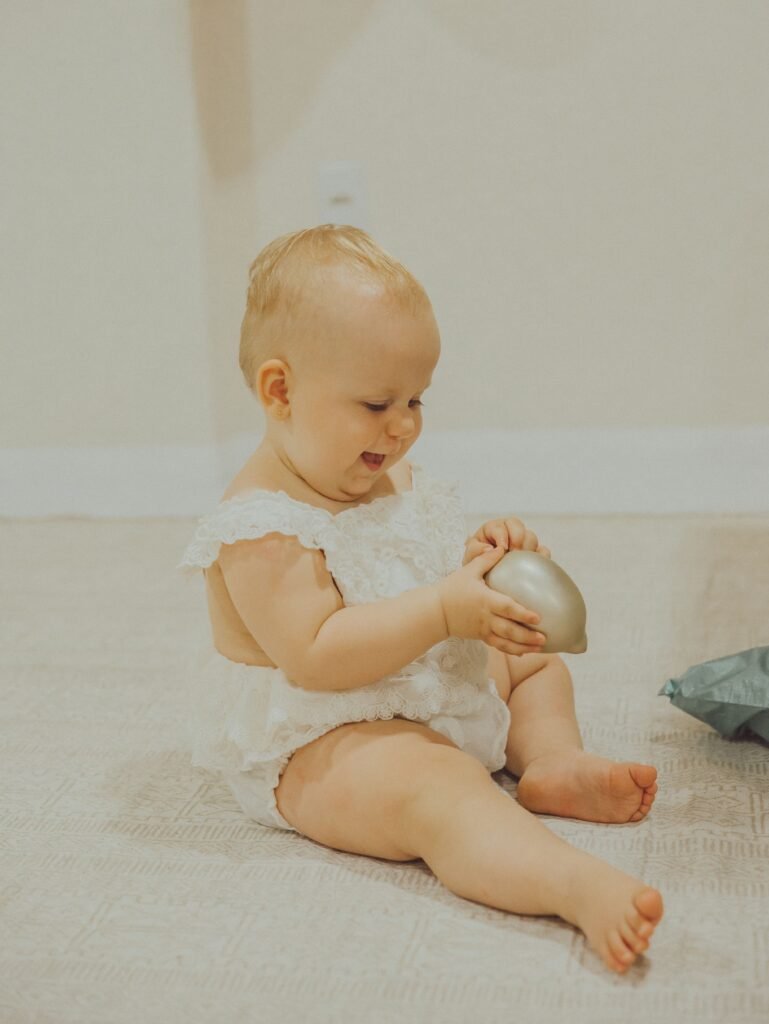
Babies do not need complicated lessons or large amounts of specialist equipment. Warm relationships, responsive interaction and opportunities to move and explore can all support development.
- Talk throughout the day: Describe what you are doing during feeding, dressing, changing and play.
- Respond to communication: Notice your baby’s sounds, gaze and gestures, then respond as though you are having a conversation.
- Share books: Look at pictures, point to familiar objects and allow your baby to handle a suitable board or fabric book.
- Sing and play: Songs, rhymes and simple games can support listening, anticipation and social interaction.
- Provide floor time: Give your baby safe opportunities to stretch, reach, roll and move while supervised.
- Follow their interests: Notice what catches your baby’s attention and give them time to explore it.
- Offer safe sensory experiences: Provide age-appropriate objects with different textures, shapes and sounds.
- Avoid comparisons: Focus on the progress your baby is making rather than what another child of a similar age can do.
All toys and resources should be suitable for the baby’s age and checked for small or damaged parts. Babies explore with their mouths, so close supervision and careful selection of resources are essential.
Baby Development Reviews
In England, parents are offered health and development reviews during a child’s early years. These reviews can cover movement, communication, social development, hearing, vision, feeding and general wellbeing.
Keep your baby’s personal child health record, often called the red book, up to date and take it to appointments. You can find more information in the NHS guide to baby health and development reviews.
Development Matters, the non-statutory guidance used within the EYFS, also explains that babies and young children do not develop in a fixed way. Its broad pathways support professional judgement rather than creating a checklist for every child.
When to Ask for Advice
Parents know their babies well. Speak to your health visitor or GP if you are worried about any aspect of your baby’s movement, communication, hearing, vision, interaction or general development.
It is sensible to ask for advice if your baby:
- loses a skill they previously had;
- seems unusually floppy or stiff;
- uses one side of their body noticeably more than the other;
- does not appear to respond to sounds or familiar voices;
- has difficulty making eye contact or engaging with people; or
- is not making progress over time and this is causing concern.
This list is not intended to diagnose a developmental condition. A health professional can consider the whole picture, answer questions and arrange further support where appropriate.
Supporting Babies at Nursery
Nursery practitioners support development by building secure relationships and responding to each baby’s individual routines, interests and communication.
Suitable floor space, sensory resources, songs, stories and responsive interaction give babies opportunities to move, explore and connect with familiar adults. Practitioners can also share observations with families so that everyone has a fuller understanding of the child’s development.
For children who continue at nursery beyond their first year, our guide to toddler development and milestones explains some of the changes families may notice next.
Understanding Developmental Milestones in Babies
Developmental milestones in babies provide a helpful overview of how movement, communication, relationships and exploration may change during the first year. They should always be used as flexible guidance rather than strict targets.
Celebrate the progress your baby makes, provide safe opportunities to interact and explore, and ask for professional advice whenever something concerns you.
Hunny Pot Nursery provides care from 12 weeks old in a nurturing environment designed around each child’s needs and development. To meet the team and see our baby provision, book a nursery tour.
Baby Developmental Milestones FAQs
What are developmental milestones?
Developmental milestones are skills and behaviours that commonly emerge as babies grow. They cover areas such as movement, communication, social interaction, thinking and coordination.
At what age do babies crawl?
Many babies begin moving independently during the later part of their first year, but there is no exact crawling age. Some crawl, while others shuffle, roll or develop another way of moving. Some babies do not use a recognisable crawling stage.
When do babies start talking?
Communication begins long before a first word. Babies communicate through crying, looking, smiling, gestures, cooing and babbling. Some may use a recognisable word towards the end of their first year, while others do so later.
Should every baby meet milestones at the same age?
No. Milestone ages are broad guides, and individual development varies. Speak to a health visitor or GP if you are concerned about your baby’s progress or if they lose a skill they previously had.