
Continuous provision in early years education gives children regular opportunities to explore, practise skills and develop their own ideas. A thoughtfully planned environment can support independence, curiosity and learning throughout the nursery day.
However, continuous provision involves more than simply leaving familiar toys and resources available. Nursery practitioners need to consider what children can learn in each area, how the environment reflects their needs and interests, and when sensitive adult support could extend their thinking.
This article explains what continuous provision means, why it matters and how early years practitioners can develop it without interrupting valuable child-led play.
What Is Continuous Provision?
Continuous provision describes the areas and resources that remain available for children to access as part of their everyday learning environment.
These might include:
- Construction and block play.
- Books and storytelling resources.
- Creative and mark-making materials.
- Role-play areas.
- Small-world play.
- Sand and water exploration.
- Puzzles and early mathematical resources.
- Outdoor movement and investigation.
Children should be able to use these areas with an appropriate level of independence. Nevertheless, practitioners remain responsible for keeping the environment safe, observing how it is used and providing support when it will benefit learning.
Good continuous provision offers enough familiarity for children to know where resources belong and how to access them. At the same time, it provides enough flexibility and challenge for children to develop new ideas.
Why Is Continuous Provision Important?
Continuous provision is important because young children learn through repeated opportunities to play, explore, communicate and practise developing skills.
When children can return to an activity, they may test a different idea, use the resources in a new way or build on something they discovered previously. Repetition is therefore not necessarily a sign that learning has stopped. It can help children consolidate their understanding and become more confident.
The environment also helps practitioners notice children’s interests, strengths and developing knowledge. These observations can inform decisions about future activities, resources and adult interactions.
Supporting the Characteristics of Effective Teaching and Learning
The current Early Years Foundation Stage statutory framework identifies three characteristics of effective teaching and learning:
- Playing and exploring: children investigate and experience things and have a go.
- Active learning: children concentrate, continue when they encounter difficulties and enjoy their achievements.
- Creating and thinking critically: children develop ideas, make links and find strategies for doing things.
Effective continuous provision can support all three characteristics. It gives children access to familiar materials they can investigate independently while allowing them to develop their ideas over time.
For example, children building with wooden blocks may experiment with the height and stability of a tower. If it falls, they can change the base, rearrange the blocks or introduce another material. Through this process, they are playing, persisting and thinking critically.
Open-ended resources can be particularly useful because they do not have one predetermined outcome. Read more about the benefits of loose-parts play at nursery.
What Does Continuous Provision Look Like?
Continuous provision will look different in every setting because it should reflect the children, available space, curriculum and stage of development.
A well-planned area should:
- Have a clear purpose connected to children’s learning and development.
- Contain suitable, accessible and well-maintained resources.
- Allow children to make meaningful choices.
- Provide opportunities for different levels of skill and confidence.
- Support communication, cooperation and independent exploration.
- Be inclusive and adaptable for children with different needs.
- Offer enough time and space for children to develop their play.
Resources should be organised in a way that helps children find, use and return them. Photographs, pictures or clear labels may support independence where appropriate.
Practitioners should also consider whether every child can participate meaningfully. Our article about inclusive practice in early years explains why provision should reflect individual strengths and support needs.
How Often Should Continuous Provision Change?
Continuous provision should be reviewed regularly, but this does not mean completely changing every area each week.
Too much change can remove the familiarity children need to work independently and develop their ideas. Conversely, an area may need adapting when it no longer supports the intended learning, children cannot access it successfully or practitioners identify a valuable opportunity to extend it.
Small, purposeful changes are often more useful than replacing everything. A practitioner might:
- Add photographs, books or vocabulary linked to an area.
- Introduce a different size, shape or quantity of construction material.
- Add writing materials to role play.
- Provide new tools for sand, water or dough.
- Adapt the height, position or presentation of resources.
- Remove damaged, unsuitable or rarely useful items.
Any change should have a clear reason. Practitioners should consider what children already know, what they are trying to understand and what experience could help them progress.
The Adult’s Role in Continuous Provision
Child-led learning does not mean adults withdraw from children’s play. Practitioners have an important role in planning the environment, modelling language, maintaining safety and deciding when interaction would be helpful.
Effective adult support might include:
- Observing before joining the activity.
- Commenting on what a child is doing.
- Introducing useful vocabulary.
- Modelling how to use an unfamiliar tool.
- Asking an open question at an appropriate moment.
- Helping children cooperate or communicate with one another.
- Adding a resource that helps develop the child’s idea.
- Stepping back when the child is confidently directing their own learning.
Adults should avoid asking so many questions that the play becomes an adult-led test. Sometimes a simple observation or carefully introduced word is enough to help the child think further.
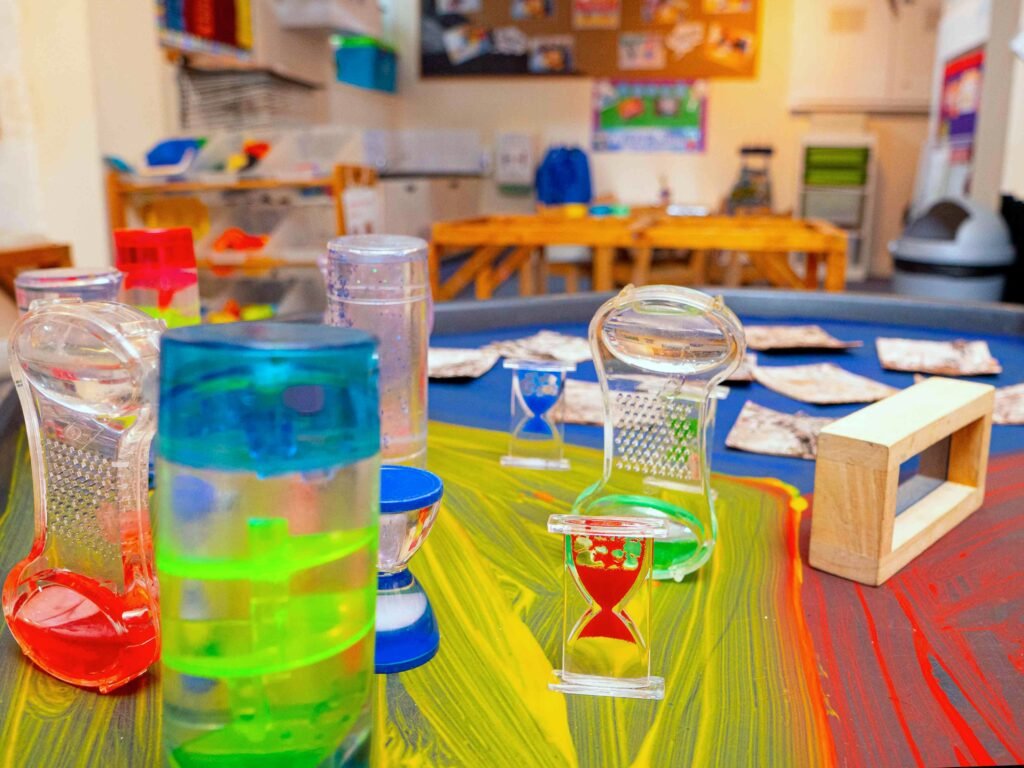
How Practitioners Can Improve Continuous Provision
Continuous provision develops through careful observation, professional knowledge and regular reflection. The following approaches can help practitioners evaluate and improve the environment.
Start with the Curriculum
Each area should contribute to the setting’s educational intentions. Practitioners need to understand what knowledge, skills or experiences the provision could support rather than adding resources simply because they look attractive.
For example, a construction area may support spatial language, comparison, coordination, cooperation and problem-solving. Knowing this helps practitioners select suitable resources and recognise meaningful learning as it occurs.
Observe How Children Use the Space
Observe which resources children select, how they use them and whether the layout creates any barriers. An unused area does not always mean children lack interest. They may find it difficult to reach, understand or use the materials.
Practitioners can then make purposeful adjustments and observe whether those changes improve children’s access and engagement.
Value Familiar and Repeated Play
Children often repeat play because they are practising a skill, exploring a familiar idea or finding emotional security in an activity they understand.
Rather than stopping familiar play, practitioners can consider whether a subtle addition or interaction could help the child deepen it. The aim is to extend learning without taking control unnecessarily.
Provide Appropriate Challenge
Resources should offer different levels of complexity so children can participate according to their development and confidence.
For instance, construction provision might include larger blocks for early stacking, smaller pieces for more detailed designs and photographs or books that inspire further ideas. The resources remain available, but children choose how to use them.
Give Children Sufficient Time
Continuous provision should not be treated merely as a short activity between adult-led tasks. Children need meaningful periods in which to settle into play, develop ideas and return to previous learning.
Nurseries still need predictable routines for meals, rest, care and transitions. Skilled practitioners can give children suitable notice, acknowledge what they were working on and help them return to an activity later where practical.
Keep the Environment Inclusive
Consider whether furniture, storage, tools and instructions enable every child to participate. Some children may benefit from visual prompts, adapted tools, quieter spaces, additional modelling or different ways to communicate.
An inclusive environment does not need to look identical for every child. Appropriate adjustments can help each child access the same broad learning opportunities.
Continuous Provision Indoors and Outdoors
Continuous provision should extend beyond the indoor classroom. Outdoor environments can offer different opportunities for movement, construction, investigation, creativity and contact with nature.
Outdoor provision might include:
- Large-scale construction.
- Sand, mud and water exploration.
- Gardening and observing living things.
- Wheeled toys and physical challenges.
- Outdoor mark-making.
- Natural and loose materials.
- Quiet spaces for conversation or stories.
The outdoor area should not simply reproduce the indoor environment. It can make use of the greater space, changing weather and natural materials available outside.
You can see examples of our indoor and outdoor environments on the Explore Nursery page.
Why Continuous Provision Matters at Hunny Pot Nursery
Continuous provision in early years education helps children become active participants in their learning. It gives them opportunities to make choices, revisit ideas, solve problems and develop confidence with suitable adult support nearby.
Effective provision combines familiar routines with thoughtful opportunities for challenge. It is informed by the curriculum, children’s development and practitioners’ knowledge of the individuals in their care.
At Hunny Pot Nursery, we provide indoor and outdoor opportunities that support children’s play, exploration and development. To see the environment and meet the team, book a nursery tour.
Pingback: Choosing the Right Nursery: School or Day Nursery?