
Nursery activities give children opportunities to play, explore and develop new skills in enjoyable ways. Through carefully planned experiences, children can build communication, confidence, coordination, creativity and an understanding of the world around them.
The Early Years Foundation Stage recognises play as an important part of children’s learning. Young children are mostly taught through games and play, supported by adults who provide suitable resources, interaction and guidance. Read more about the Early Years Foundation Stage on GOV.UK.
Many of the best nursery activities use simple, open-ended materials. This allows children to make choices, test ideas and use their imagination rather than working towards one fixed outcome.
Why Are Nursery Activities Important?
Nursery activities support different areas of learning at the same time. For example, building with blocks may involve physical control, problem-solving, language and cooperation.
Children can also revisit activities and develop their ideas over time. An adult may introduce new vocabulary, demonstrate a technique or ask a question, while still allowing the child to take the lead.
Activities should always be suitable for the child’s age and development. Resources also need to be checked carefully, especially when younger children may place objects in their mouths.
1. Sand Play
Sand play allows children to scoop, dig, pour, mould and sift. These actions help develop coordination, grip and control while introducing concepts such as full, empty, heavy, light, wet and dry.
Children may create roads, cakes, castles or imaginary landscapes. When playing together, they can also practise sharing tools, explaining ideas and taking turns.
Sand should be clean, suitable for play and supervised appropriately. Very young children may need close support to prevent sand from being thrown or placed in their mouths.
2. Water Play
Water play gives children opportunities to investigate pouring, floating, sinking, movement and capacity. Jugs, funnels, cups, brushes and water channels can all support simple scientific and mathematical thinking.
Children may compare containers, predict which objects will float or work together to move water from one place to another.
Water activities require close adult supervision, even when only a shallow amount of water is used. Read more about the benefits of outdoor water play.
3. Playdough
Rolling, squeezing, pinching and shaping playdough helps strengthen the small muscles in children’s hands. These movements support later skills such as using cutlery, fastening clothes, drawing and writing.
Children can use age-appropriate cutters, rollers and larger tools to create shapes, patterns and imaginary objects.
Playdough should be non-toxic and supervised. Avoid adding small decorations or loose pieces that may present a choking risk to younger children.
4. Dressing Up and Role Play
Dressing up allows children to explore familiar roles and imaginary situations. They might pretend to be a doctor, shopkeeper, builder, chef, firefighter or family member.
Role play encourages language, storytelling, cooperation and empathy. It can also help children make sense of experiences such as visiting a doctor, travelling on a bus or starting school.
Putting on simple costumes, hats or jackets can also support independence and self-care. Dressing-up resources should be comfortable, easy to remove and free from long cords or damaged fastenings.
5. Cooking and Pretend Cooking
Simple cooking activities can introduce children to ingredients, measurements, textures and changes that happen when foods are mixed or heated.
Depending on their age, children may help wash fruit, stir ingredients, spread toppings or count spoonfuls. Adults must manage allergies, hygiene, hot surfaces and suitable food preparation.
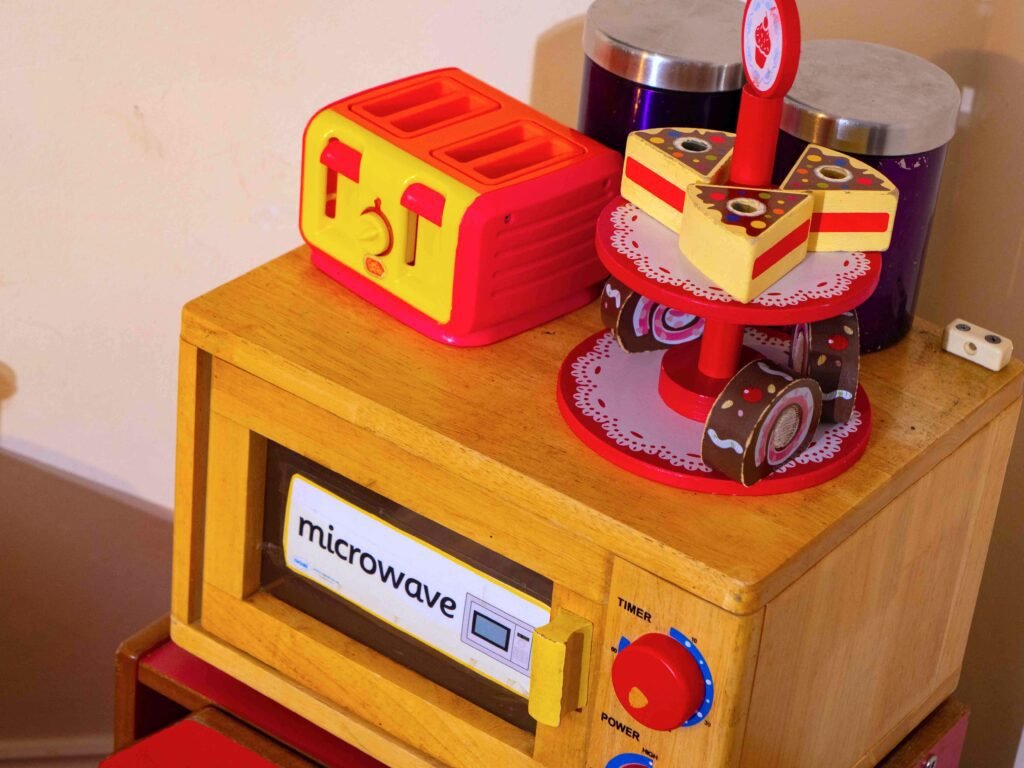
Pretend cooking provides similar opportunities for language and imaginative play without using real food. Children may create a café, restaurant, bakery or home kitchen using safe play resources.
Learn more about meals and nutrition at Hunny Pot Nursery on our Our Menus page.
6. Cardboard-Box Play
A large cardboard box can become a house, vehicle, shop, tunnel, puppet theatre or den. Because it has no fixed purpose, children can decide what it represents and change their ideas as they play.
Adults can provide crayons, paper, fabric and other suitable materials to extend the activity. Staples, sharp edges, plastic packaging and small loose parts should be removed before the box is used.
This is a simple example of open-ended or loose-parts play. Read more about the benefits of loose-parts play at nursery.
7. Music, Singing and Dancing
Music encourages children to listen, move and respond to different sounds. Songs can introduce rhythm, rhyme, repetition, counting and new vocabulary.
Dancing supports balance, coordination and large physical movements. Children can copy actions, invent their own movements or use safe instruments to create different sounds.
Group music sessions may also encourage confidence and participation, although children should be allowed to join in at their own pace.
8. Imaginative Small-World Play
Small-world play uses figures, animals, vehicles, buildings or natural materials to create miniature scenes. Children may recreate familiar experiences or invent completely new stories.
This type of play supports storytelling, sequencing, problem-solving and emotional expression. Adults can join the conversation without taking control of the story.
All figures and accessories must be suitable for the child’s age. Small pieces should not be offered to children who may still place objects in their mouths.
9. Nature and Outdoor Play
Outdoor play gives children space to move, observe nature and experience changing weather and seasons. Activities may include collecting leaves, digging, growing plants, making mud recipes or searching for insects.
Natural materials can encourage sorting, counting, pattern-making and imaginative play. Children can also develop physical confidence by balancing, climbing and moving across different surfaces with suitable supervision.
Explore the indoor and outdoor learning spaces at Hunny Pot Nursery on our Explore Nursery page.
10. Safe Sensory Play
Sensory activities allow children to explore texture, sound, colour, movement and smell. Suitable materials may include water, foam, dough, paint, fabric, large natural objects or cooked food prepared specifically for supervised play.
Resources should be selected according to the child’s age, allergies and developmental needs. Avoid raw jelly cubes, water beads, small beads and other items that could be swallowed or inhaled.
Some children enjoy messy sensory experiences, while others may prefer tools, gloves or less direct contact. Providing choices allows children to participate in a way that feels comfortable.
Trying Nursery Activities at Home
Many nursery activities can be adapted for home without expensive equipment. A washing-up bowl can become a water tray, cushions can create an obstacle course and a cardboard box can support hours of imaginative play.
Follow your child’s interests and keep activities manageable. You do not need to direct every moment or produce a finished result. Often, the most valuable learning happens while children are testing their own ideas.
Nursery Activities at Hunny Pot Nursery
The best nursery activities combine enjoyment, exploration and appropriate adult support. Each child will respond differently, so a varied environment gives children opportunities to discover what interests and motivates them.
At Hunny Pot Nursery, children take part in a range of indoor and outdoor experiences designed around their age, interests and development. You can also read more about why play is important for children.
To meet the team and explore the nursery, book a nursery tour.