
The benefits of outdoor water play reach across many areas of early learning. Young children can explore, experiment and learn through their senses while developing physical, communication, social and problem-solving skills.
Outdoor water play can be incorporated into nursery provision throughout the year when the weather and conditions are suitable. Activities should always be closely supervised and adapted to each child’s age and stage of development.
What Are the Benefits of Outdoor Water Play?
Outdoor water play includes activities that allow children to pour, scoop, transfer, mix and investigate water using suitable containers, toys and tools.
It might involve a water table, a shallow tray, buckets, watering cans, channels, brushes or containers of different sizes. Adults can also add carefully selected natural materials and objects to encourage investigation.
Open-ended water play gives children freedom to make choices and test their own ideas. There is no single correct outcome, so the same resources can lead to different discoveries each time.
Useful Equipment for Outdoor Water Play
Simple resources can provide plenty of opportunities for exploration:
- Shallow water trays or tables.
- Buckets, bowls and jugs.
- Cups and containers of different sizes.
- Funnels, scoops, sieves and ladles.
- Watering cans and spray bottles designed for children.
- Brushes, sponges, pipes and water channels.
- Objects suitable for floating and sinking investigations.
Equipment should be suitable for the children using it, checked for damage and positioned so that children can reach it safely without climbing into containers.
Keeping Outdoor Water Play Safe
Children require close adult supervision whenever they are playing in or near water, including shallow trays, buckets and paddling pools.
- Remain close enough to respond immediately.
- Empty paddling pools and water containers as soon as the activity finishes.
- Keep the surrounding surface as clear and slip-resistant as possible.
- Use clean water and suitable, clean equipment.
- Prevent children from drinking activity water.
- Adapt the activity for children with additional needs or reduced mobility.
During warm weather, provide shade, suitable clothing, drinking water and appropriate sun protection. Sunscreen may need to be reapplied after water play or towel drying. Parents can also read the NHS baby and toddler safety guidance.
1. Encourages Calm and Focused Play
Pouring, scooping and watching water move can provide a calm and absorbing activity. The repetitive nature of filling and emptying containers may help some children remain engaged while exploring at their own pace.
However, children respond differently. Some may enjoy quiet investigation, while others prefer energetic splashing and movement. Both approaches can provide useful learning opportunities when managed safely.
2. Develops Fine Motor Skills
Holding cups, squeezing sponges, turning taps and using small tools can strengthen the movements needed for fine motor control.
As children attempt to pour water accurately, they also practise hand-eye coordination, grip and control. Adults can offer containers of different shapes and sizes so children can adjust their movements.
3. Supports Gross Motor Development
Outdoor water play can also involve larger movements. Carrying a suitably light watering can, reaching across a water table, brushing a wall with water or moving between containers all require balance and coordination.
Resources should not become too heavy when filled. Adults can provide smaller amounts of water and encourage children to carry containers using both hands where appropriate.
4. Builds Language and Communication
Water play introduces useful descriptive and action words, including:
- Pour.
- Drip.
- Flow.
- Splash.
- Full and empty.
- More and less.
- Fast and slow.
Adults can build language naturally by commenting on what children notice and adding new words to their conversations. Children may also explain their ideas, ask questions and cooperate with others during shared activities.
5. Encourages Creativity and Imagination
Water is an open-ended resource that can become part of many imaginative games. A tray may become an ocean, a washing station, a café or part of a scientific investigation.
Children can choose their own materials and decide how to use them. This gives them opportunities to take initiative, develop ideas and adapt their play as it unfolds.
6. Provides Sensory Experiences
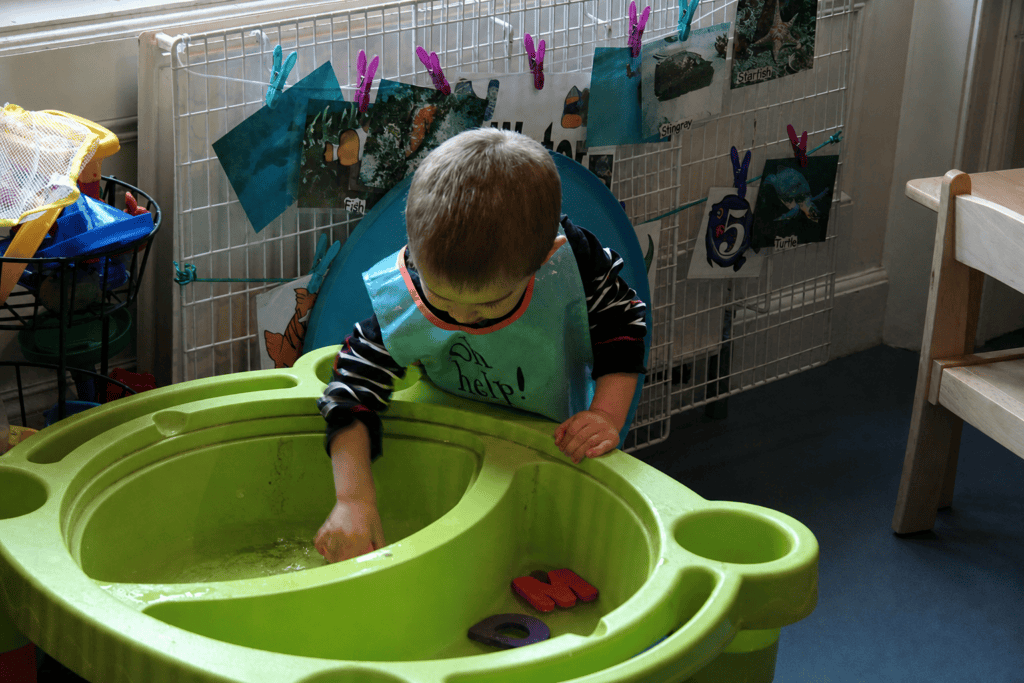
Water allows children to investigate temperature, movement, sound and texture. They can also observe how suitable materials change when they become wet.
For example, children might explore water with sand, leaves, stones, brushes or sponges. Any added materials should be age-appropriate, non-toxic and carefully supervised.
7. Introduces Early Scientific Thinking
Water play encourages children to notice patterns, make predictions and test ideas. They may investigate:
- Which objects float or sink.
- How water travels through pipes and funnels.
- How different materials absorb water.
- Why water flows downhill.
- What happens when water is frozen or warmed safely.
Adults can support this thinking by asking open questions such as, “What do you think will happen?” and “Why do you think the water moved that way?”
8. Supports Early Mathematical Understanding
Containers of different sizes provide opportunities to explore capacity, comparison and quantity.
Children can compare which container holds more, count scoops, notice when a vessel is nearly full and investigate how many small cups are needed to fill a larger jug.
These practical experiences help mathematical language become meaningful through play.
9. Develops Problem-Solving and Concentration
Children often encounter small problems during water play. A funnel may overflow, a channel may need repositioning or a container may be too small for the task they have chosen.
Working out what to change encourages persistence, flexible thinking and experimentation. When children are interested in the activity, they may remain focused while trying different solutions.
10. Encourages Cooperation and Social Skills
Shared water activities give children opportunities to take turns, exchange tools, explain ideas and work towards a common goal.
For example, one child might pour water while another adjusts a channel or collects it at the other end. With adult support, children can negotiate roles and learn how their actions affect other people’s play.
Water play can also be enjoyed independently. A balanced environment should provide space for children who prefer quieter exploration as well as opportunities for cooperative activity.
Making Water Play Part of Outdoor Learning
The benefits of outdoor water play can be seen across several areas of children’s development. Activities can also be adapted for different ages, interests and abilities. The strongest experiences are usually simple, open-ended and responsive to what children are trying to discover.
You can read more about the importance of play for children and explore our indoor and outdoor environments on the Explore Nursery page.
To see how Hunny Pot Nursery supports learning through play, book a nursery tour.
Pingback: Nursery Activities: 10 Fun Ideas Children Will Love